
At a time when the global job scenario is gloomy, India Inc is expected to increase salaries up to eight per cent this year with infrastructure and FMCG sectors likely to see the maximum hikes, global HR consultancy Mercer says.

LG Electronics India made a dazzling market debut on Tuesday, ending 48 per cent higher than its issue price and surpassing its South Korean parent in market value.

Indian corporate are fast tapping the international bonds market to raise funds for their operational expenses even as they reduce their presence in the rupee bond market. As bonds are costlier for companies and investors are more sceptical than the banks, chief financial officers say they are looking at other avenues for raising funds in the coming months as dollar bond rates are lower in the range of 100 to 250 basis points. "For corporate with reasonable credit quality, the Indian bond market has become less of an option from a cost point of view. "In addition, conditions imposed in the Indian bond market by investors post Franklin episode have also become very onerous," said Prabal Banerjee, president-finance of Bajaj group. "Hence very few corporate are looking at the local bond market for resource mobilisation, since both, bank loans and the overseas bond markets are much more attractive," he said.

Just before the 2008 financial crisis made headlines, Indian companies were on a global buying spree. In the fifth part of the series, Dev Chatterjee and Krishna Kant discuss how the crisis came as a black swan event for some, changing the mood from exuberance to despair.

No business delegation has been cleared yet for Prime Minister Narendra Modi 's visit to America from Friday.

India Inc on Thursday expressed fear that the RBI's decision to raise key short-term rates will push up the cost of borrowing, making some of their projects unviable and hurting expansion plans.

The stimulus packages should continue for another year or at least till October 31, he said, pointing out that the economy is yet to achieve the pre-crisis level of nine per cent.

RIL, Capgemini, IndiGo among companies which have offered to pay their employees' vaccination cost.

The government's move to set up a regulator for the coal sector would help bring in transparency, encourage exploration and enhance quality of the dry fuel, India Inc said on Friday.

At least 150 companies, including some from the Tata Group, have started collecting data about their SC/ST employees, as India Inc is no more "caste blind", according to a CII paper on affirmative action.

Yunus will teach India Inc why and how social business is not charity but business wherein a surplus is passed on to the target group of beneficiaries in the form of lower prices, better service and greater access

While some such as Hindalco, JSW Steel, India Cements, Essar Oil, Tata Steel and Jet Airways have already announced plans to raise a combined Rs 70,000 crore, there are many who are redrawing proposals to enter the market to raise money.

According to the survey by Hong Kong-based HR Business Solutions, Asia Pacific's average pay increase (expected) for 2010 is 4.8 per cent, higher than an actual pay increase of 3.2 per cent in 2009.

Aggregate figures for a sample of 43 companies (excluding oil & gas PSUs as well as those in the banking, telecom and software sectors) in the BSE 100 index suggest that operating profit margins (OPMs) were down by 63 basis points (bps) year-on-year in the December quarter and that there appears to be no major causes for concern.

India's top listed companies reported their best-ever quarterly net profit of Rs 2.39 trillion in the September quarter of FY22, up 46.4 per cent year-on-year. The earnings were driven by a big surge in the profitability of banks, non-banking financial companies & insurance (BFSI), oil & gas, and metal & mining firms. The combined net profit of these three cyclical sectors were up 87 per cent YoY to a record high of Rs 1.53 trillion, up from Rs 82,000 crore a year ago and Rs 1.08 trillion in Q1FY22.

India Inc has too much on its plate to ensure double digit growth in FY16.

Hailing Prime Minister Narendra Modi's Make in India campaign and the emphasis on ease of doing business, India Inc today said the initiative mirrors the country's ambition to sprint ahead in the global manufacturing race, thereby creating jobs and boosting economic growth.

India Inc is expected to post 35-45 per cent rise in net profit in the fourth quarter ended March 31.

Corporate earnings grew in double digits during the April-June 2022 (Q1FY23) quarter but the momentum waned. Overall corporate earnings in the quarter were down sharply from their highs in FY22. The combined net profit of 2,981 listed companies across sectors in the Business Standard sample was up 22.4 per cent YoY to Rs 2.24 trillion in the June quarter, driven by a big jump in the earnings of banks, non-banking lenders, oil & producers, and FMCG companies. Also, earnings in the corresponding quarter a year ago were affected because of the second wave of the Covid pandemic, even though the numbers were a lot better than Q1FY21 when there was a nationwide lockdown.
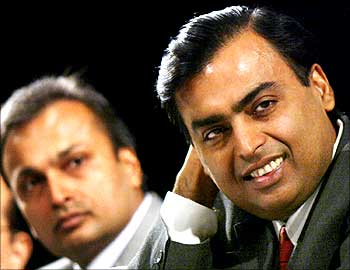
In peace and at war, firms remain tethered to promoter families in a uniquely Indian way.
India Inc has mobilised a record over Rs 32,000 crore (Rs 320 billion) through issue of shares on rights basis in fiscal 2007-08, driven by the mega issues from State Bank of India and Tata Steel, a latest report says. Corporate India has raised Rs 32,518 crore (Rs 325.18 billion) through right issue in the last fiscal, a jump of over eight-fold as compared to Rs 3,703 crore (Rs 37.03 billion) that was raised in FY 2006-07.

'Our problem is not a budget deficit but a trust deficit. We need to trust our institutions and industries to innovate and lead. That is the way forward for India.'

India Inc is likely to post a whoping 63 per cent growth in net profit in the second quarter, thanks to four oil marketing companies which are expected to post a combined net profit of Rs 2,730 crore (Rs 27.30 billion) in the quarter ended September.
India Inc on Friday said it is looking forward to a repo rate cut in future as cost of funds has to come down in coming times, and expects continuation of accommodative policy stance by the Reserve Bank of India (RBI). The RBI decided to leave the benchmark interest rate unchanged at 4 per cent but maintained an accommodative stance, as the economy faces the brunt of the second COVID-19 wave. Sanjay Aggarwal, president of PHD Chamber of Commerce and Industry, said the RBI has maintained an accommodative stance as long as necessary to revive and sustain growth on a durable basis and to mitigate impact of COVID-19, apart from an aim to keep inflation within the target.
External commercial borrowing and short-term credit from abroad, which met more than 20 per cent of India Inc's credit needs in the 2007-08 fiscal, have contributed only 8.2 per cent of the financing needs. However, bank credit has increased by nearly Rs 38,000 crore (Rs 380 billion) in the current fiscal, meeting 61 per cent of fund requirement for companies.
The early bird results for the January-March 2022 quarter (Q4FY22) hint at a slowdown in corporate sector growth in the upcoming quarters. The combined net sales of the 81 early bird companies in the Business Standard sample were up 15.1 per cent year-on-year in Q4FY22; this was less than the 15.9 per cent YoY jump reported in Q3FY22. The slowdown could be much stronger for the domestic market-focused companies, including those in the banking, finance, and insurance (BFSI) space.

The slowdown in capital expansion is clearly seen in the current financial year. Large sectors such as cement, metal, oil and gas, power and telecom have provided negligible funds in the first quarter for their capex plans.

Corporate India's deal activity in the period between January till March this year was better than last year.
India's corporate sector is likely to report a slowdown in revenue growth and earnings for the July-September 2023 period (Q2FY24), according to earnings estimates by brokerages, after the country's top listed companies posted higher than expected profits for the first quarter. The combined net profit of Nifty50 companies, based on brokerage estimates, is expected to have grown by 19.6 per cent year-on-year (Y-o-Y) to Rs 1.75 trillion in Q2FY24 - a sharp deceleration from 37.6 per cent Y-o-Y growth in the combined earnings of index companies in the April-June 2023 period. According to estimates, the combined earnings in the second quarter would be down 8.8 per cent on a quarter-on-quarter (Q-o-Q) basis and the lowest in the past three quarters.
Stresses on need to boost investor sentiment through stable regulation.
India Inc on Friday said Prime Minister Manmohan Singh's assertion that the government will not impose capital controls, although reassuring to investors, must be supplemented with tough reform measures.

The Delhi high court on Monday sought responses from the Centre and the Competition Commission of India (CCI) on Apple Inc's plea challenging recent amendments to the Competition Act that allow penalties to be based on a company's global turnover.
.jpg)
Net profit grew 25.4% in Q4 but revenue growth, lower at 8.5%, suggests lack of volume expansion.

Across the country, companies have stepped up their act to contain the crisis. IT and other new economy firms seem to have taken a lead.

2025 has seen a sharp rise in lawsuits targeting IT services and consulting companies, which now increasingly offer proprietary digital platforms and cloud services.

Wishlist for new PM includes growth boosters, reining in inflation, faster project clearance and reversal of Land Acquisition Act

GST 2.0 may cushion consumers against US tariffs, but like the 2019 corporate tax cut, it risks being another tactical fix rather than a structural growth strategy, expects Debashis Basu.

Passenger fares and freight rates were left untouched
